Showing posts with label loving and respecting others. Show all posts

Friday, September 18, 2015

Reflections from my time in Uganda

I just came across this draft of a blog post that I wrote while I was in Uganda last year. It really surprises me how much I had forgotten about from my experience there. Here are my reflections on spending a month living and volunteering in Kampala, the capital of Uganda in 2014.

***

Kampala, Uganda

I keep searching for some sort of point I want to make based on my experiences here, but for the most part nothing is coming up. I've thought about writing about how it feels to be white in a country that's something like 99.5% indigenous, or how confusing I've found the social norms about touching, or how sometimes people seem more friendly here than in Boston.

I'm scared to write about my experiences in Uganda, because I'm pretty sure there are books about how offensive the ways that Westerners tend to write about Africa are. Since I'm white and relatively rich, I'm the perfect candidate for being ignorant about this sort of thing.

Also, I don't really know what to say. I haven't learned any concrete life lessons that I can think of, and I don't have any insightful observations. I guess this is because Africa, Uganda, Kampala are real places with all different kinds of people, places, and things. I don't want to make it into a caricature of a place just so I have something definitive to say.

I'm just going to share with you some general observations and reflections, and if I'm coming at it from an offensive angle, it could be good to get constructive criticism on that.

1. Touching seems to have very different connotations here. I still don't really understand it. Men that I work with (I mostly work with men) sometimes hold my hand for minutes at a time, or rub my arm while they're talking to me. I'm told that hand holding is not considered romantic here, but I always feel like they're coming onto me when this happens. I'm not sure if it's a gendered thing; I hear men hold hands casually with each other, too.

2. There are a lot of large, concrete walls with barbed wire separating properties. Also, there are lots of men with gigantic guns standing around; I'm told they're security guards, hired by local businesses.

3. People (mostly men) call out to me constantly as I walk down the street. They say, "Hello, how are you?" or, "Muzungu, how are you?" (muzungu = white person; I'm told it's not a derogatory term). At first I thought this was street harassment, so I didn't respond, but then I saw that my female friend just said hello back. I tried that, and found that the conversation usually ends there. Sometimes people are trying to sell me things, but often it seems like they're just curious. Every once in a while it's, "Hello baby!" and then I don't respond.

4. I feel like an outsider, but not really in a bad way. I expected people here to resent me for having so much more privilege and resources than most of them, but I haven't gotten that impression from anyone. People do seem to assume that I'm rich because I'm white, but they aren't hostile to me; they just want me to buy their products/services.

And they're right -- I am rich here. It's really weird for me. I can go to the fanciest restaurant I find (there are plenty of fancy restaurants here), buy an entree, a cocktail, and dessert, and it might cost me around 40,000 shillings (about $16).

In Boston, I'm more frugal than most of the people I know. I try to limit my unnecessary spending because it seems unfair for me to have much more than I need, while so many other people in the world don't have enough. But I'm skeptical of charity, and haven't found a way to combat financial inequality that I feel confident in. So I end up not spending much, and not donating much, and having money leftover.*

While I'm in one of the poorer countries in the world, it seems to me like it makes sense to spend money more frivolously. Isn't supporting local businesses a pretty direct way to get money to people with less money and resources?

Shopping at the market feels like a very direct way of supporting local Ugandans. I don't know what the shop owners' financial situations are like, but most of the shops are shacks that resemble the houses in the nearby slums, so I'm under the impression that they're not on the richer end of the Ugandan wealth spectrum. Conveniently, I really like shopping at the market. It's full secondhand clothes (my favorite), local produce, and often cute animals wandering around.

I usually barter when buying something at the market, partly because everyone I know tells me to. Also, I get the impression that people expect you to barter, so they jack up the price when you ask how much something is (prices are rarely marked). If I take it for the first price, I feel like I'm getting ripped off. But it seems weird to try to pay less for something when I can afford the higher price, and the money is likely worth much less to me than it is to the person I'm bartering with. On the other hand, I wonder if it would be ostentatious for me not to barter, because it is a part of the shopping experience.

5. I regularly find myself at fancy restaurants and touristy stores, which feels uncomfortable. Sometimes almost everyone in those spaces is white, and I wonder why I've gotten myself into a white people bubble in the middle of a 99.5% brown country. Sometimes when I go to these places it's because someone I know invites me to them, and other times it's because I feel physically safe going there alone, and they have things I'm used to (i.e. they take credit cards, I don't need the menu items explained to me, etc.).

*Note: At the time of publication, this is no longer the case. I spend a lot more money on housing than I used to, and I make less money than I used to because of irregular work hours.

Wednesday, August 15, 2012

Porn: Helpful or harmful?

From Indie Porn Revolution

In reading an article that I expected to say a lot of Stuff I Like To Hear, I found myself challenged by an argument against porn. It went something like this:

"Porn ruins authentic physical intimacy. It makes real sex unsexy..."

I agree that mainstream porn promotes unusual body types (for women: skinny, big boobs; for men: muscular, big penis) as the "norm," which leads people to hold themselves and their partners to unrealistic standards. A man I had a fling with last year once told me, in a frenzy of enthusiasm for my body, "You look like a porn star!" Rather than feeling complimented, I felt objectified to be told that my body fit into the standards of beauty/sex appeal that our society had jammed into this man's brain.

But is porn inherently harmful, or is it just that popular porn often presents unrealistic depictions of people and sex that degrade real people and real sex?


My opinion is that:

1. Porn is a form of erotic art;

2. Erotic art is a valuable part of our culture because humans are sexual beings (which is a good thing) and erotic art appeals to that and helps us to express and enjoy that part of ourselves;

3. Porn that represents humanity and sex accurately and ethically is good for the above reasons.


And guess what!

It seems that ethical porn exists. Here is a directory:
(Taken from this article, not written by me)


Heather Corrina
The goddess herself. Also check out her sex-positive webzine and teen sexual health site.
Erotic Red
Feminist menstruation porn by women of all shapes and sizes who are, naturally and authentically, on their period. As the woman who runs the site writes, “In an industry where photos of women being throat-fucked and pissed on are commonplace portrayals of human sexuality, women enjoying themselves on their periods are viewed by most pornographers as horrifyingly obscene.” Erotic Red is out to change that.
VegPorn
One of my fav’s with models of all shapes and sizes. This site features only vegetarian and vegan models and is very inclusive of gender and sexual diversity including queer and trans models. It’s also woman-owned. I’ve thought of applying to model here, but am somewhat afraid of losing my job or causing a local scandal…which is usually a sign that you should not do something!
Indie Porn Revolution
“Porn that doesn’t fake it!” A great site with self-proclaimed “radical porn” that is inclusive of all natural body types and embraces queer and transfolk. Porn with a political edge.
Good Dyke Porn
A brilliant new site based out of Vancouver with all lesbian, bisexual, queer women and transfolk artists. I especially love this site because they go out of their way to eroticize safer sex. You’ll see lots of gloves, dental dams, condoms, lube, and consensual kink on this site.
Furry Girl
The official site of Furry Girl, who also owns and runs Erotic Red and VegPorn and a vegan sexual aid shop. Furry Girl is an all-natural, hairy, self-proclaimed feminist that really gets the difference between the mainstream sex industry and pro-sex feminist pornography.
Berg’s Queer Foot Porn
Berg is a close friend of mine. Her site may or may not actually be porn…it’s up for debate, but this website is brilliant. It is a feminist deconstruction of women’s pleasure and a manifesta against violence against women. Coming from an anti-rape perspective, Berg’s critique of society and sexuality is truly poignant. I encourage you to check it out.

Monday, May 21, 2012

Post-Christian ethics, or: How to be a "good person" without an absolute moral code

I used to read the bible a lot (note the resemblance of my hair to a Hershey's Kiss). 

I recently met someone who struck me as a really "good person" and, in my bout of idealized esteem for this person, felt that I wasn't "good enough" to deserve for him to think the same thing about me. This sounds like your run-of-the-mill low self-esteem insecurity problem, but I don't think that's what it is -- I think that I logically believe that I am lacking in the "being a good person" department, and have been for years.

Why would I think this about myself? Let me give a little background information:

I was a conservative Christian from the ages of 13 to 19 -- some very formative years. During this time, I adopted the standard conservative Christian ethical living guidelines (lets call them SCCELGs, "skelgs"):

-No drinking

-No drugs (with the exception of the widely accepted caffeine, and possibly others)

-No swearing

-No lying

-No blaspheming

-No sex until marriage

-No non-heterosexual anything, etc.

Of course it was hard to adhere to such strict rules, but in one way it was easier than the alternative: I didn't have to determine moral guidelines for myself; they were just given to me (by other Christians).

There were some times that I had to Think For Myself about how to apply the SCCELGs in a certain situation, but for the most part, moral decision making was very black and white (i.e. "I will not try alcohol because it is wrong").

Then, when I decided I was no longer a Christian at the age of 19 (this meme sums up my reasoning), I had to come up with my own, personalized set of ethical living guidelines (ELGs, rhymes with "skelgs").

In my quest for my own ELGs, it seemed fitting to try things out before writing them off as "immoral" (with some exceptions, like murder) so I decided that it was okay if I made mistakes and did things I would later determine to be "bad" in the process of trying to figure out my ethical living guidelines.

Two years later, I am surprised to find that I am still living by this "try to do good, but if you don't know whether something is good or bad, try it" principle.

What I didn't realize when I first came up with this principle was that I will probably never decide on an absolute, complete, timeless set of ELGs -- which means that this "phase" of experimentation (and leeway for wrongdoing) could last the rest of my life.

So how do I hold myself to a high moral standard when I don't have an absolute set of ethical living guidelines? Well, I have a few ideas:

1. Rather than trying really hard to avoid making mistakes, I will make an effort to do the most good I can, with an emphasis on treating people well in everyday life. I'll remind myself to enjoy doing good things for others, not "cut corners."

2. Listen to my gut feeling more. The things I've done recently that I ended up regretting were all done when I was extremely unsure to the point of being hesitant. I'll raise the bar a tiny bit for how sure I should be before trying something: I should at least be at "totally unsure," not at "leaning towards no."
Spectrum of Certainty

3. Keep actively working on figuring out my ethical living guidelines. Even though I don't see myself declaring a set of ELGs that are as absolute and complete as the ones I knew as a Christian, I do think that I can come up with some guidelines to use as a starting point for ethical decision making. For example, I see myself eventually making a decision about whether or not I think drinking is a good thing for me (I like drinking, I don't generally do too much regrettable stuff when I'm drunk, but what about the time I was drunk and my friend was having a major crisis and I couldn't drive to see him? Should I refrain from drinking in order to always be available to meet the needs of the people I love in case they need me?)

4. Figure out some sort of way of being spiritual. I'm not looking to be religious, but I think a spiritual life can be rewarding and nourishing to my sense of self. I find that nature makes me feel spiritually fulfilled, so I intend to focus my spiritual pursuits around it.

How do you figure out your ethical living guidelines? Whether you're religious or not, it takes some intense consideration. What works for you? Is there anything you want to try to work toward being more ethical?

Monday, February 13, 2012

Rat empathy: Chipping away at the notion that humans are more enlightened than other animals

A rat allowed to roam around eventually figured out how to set free a trapped cagemate. Rats didn’t offer the same courtesy to stuffed animals, suggesting the creatures have empathy for one another.

“As humans, we tend sometimes to have this feeling that there’s something special about our morals.” 
-Christian Keysers, neuroscientist

In a recent study, University of Chicago researchers put a rat into a small cage and allowed another rat to roam free amongst the caged rat for an hour each day. The free would rat immediately attempt to free the caged rat by digging and biting at the cage. After about seven days of this, the free rat would figure out how to open the cage. The two rats would then celebrate with "a frenzy of excited running" (quote from this article).

23 of 30 rats learned to open the cage for trapped rats, but only 5 of 40 rats opened the cage if it was empty (the same went for cages filled with a stuffed animal).

“They are affected by what the other is experiencing"
-Matthew Campbell, psychologist

Researchers also presented free rats with both a caged rat and 5 caged chocolate chips ("These rats adore their chocolate." -study coauthor Inbal Ben-Ami Bartal). When presented with the option to open the cages, half of the rats freed the caged rat first. And some "hero" rats even shared the chocolate with their newly freed friends -- on purpose. “It’s not like they missed a chocolate,” Bartal says. “They actually carried it out of the restrainer sometimes but did not eat it.”

What does this say about the view that humans are the only moral creatures? Or that humans are the only creatures with the capacity to think? Are we actually higher on the scale of beings, or are we just different in the same way deer and fish are different from one another?

I find that the notion of humans being above animals is widespread in our culture, even among animal lovers. I frequently hear loving pet owners teasing themselves for "the things I do for these animals." The belief behind this statement is that pets are really not worth the effort it takes to prepare their meals from scratch (in the case of illness or food allergies), spend money on daycare to prevent them from being alone for several hours at a time, etc. However, these are things that any good parent would unquestionably do for his/her children. Are human children more deserving of a good life than animal dependents?

I think that in general, humans are naturally inclined to have stronger attachments to other humans than to animals, so it makes sense that we would prioritize our children over our pets. However, I think that animals are equally as deserving of care, love, and consideration as humans are.


"The pathetic, objectionable truth about our humanity is that all we are is bipedal, potty trained, grave-making animal fuckers who shave their fur off and think that somehow we're above all else that crawls on the land we've dynamite blasted flat."
-Casey Rocheteau, local poet

Monday, December 5, 2011

Us us us us us us, and them them them them them them: Americans & Iraqis

My hope is that this post allows various Iraqi voices to speak for themselves, rather than me making a case for them.


"You're American and we're Iraqi. You're not Bush and we're not Saddam."
-ANONYMOUS IRAQI MAN

Quote as recalled by United Statesian activist Jodie Evans. The man was responding to her question: "Why are you being so nice to us?"

Jodie Evans spoke at this year's Connecting for Change conference, which I went to and enjoyed. Presenters and workshops explored topics including youth empowerment, environmental activism, women's rights, local food, alternative journalism, healthy school lunches, and wild edibles*.
 
*This link is for the 2012 wild edibles workshop because I couldn't find a page about the one they had in 2011.

You can see Jodie's entire 22 minute speech here.


Shoot an Iraqi describes an artistic endeavor of Wafaa Bilal, an artist and professor who immigrated to the U.S. from Iraq in 1992 to escape repression under Saddam Hussein’s regime. In 2007, he spent a month in a small Chicago gallery in the line of fire of a paintball gun that people could shoot at him over the internet. Internet viewers could also see and chat with Wafaa. By the twentieth day, he had been shot at over 40,000 times, and hackers had programmed the gun to fire automatically. By the end, more than 60,000 people (people, not just shots) from 130 countries shot at him.

Yellow paintballs were used because yellow is the color of the Support Our Troops ribbons


"Uprooted" by Iraqi artist, Naman Hadi

"Birth" by Iraqi artist, Dalia Mohammad

"Kliem of the South" by Iraqi artist, Ahmed Nussaif


Also,

Sunday, November 27, 2011

Nobody is ridiculous or bad or disgusting, says Vonnegut


When his father accuses him of never writing a book with a villain in it, Slaughterhouse Five's narrator (who claims to be Kurt Vonnegut himself) attributes this to his college education, which taught him that "there was absolutely no difference between anybody" and that "nobody was ridiculous or bad or disgusting."


Nobody is ridiculous.

When Jennifer Lopez demands that her coffee be stirred counterclockwise, she is still a being whose thought processes and opinions are just as valid as anyone else's, even if others don't always understand them.

Though calling a person ridiculous isn't usually considered very mean, it seems to be refusing to see him/her as a whole person. This is dehumanization, which may be the root of hatred (or at least a prerequisite to hatred).


Nobody is bad.

When a man cuts his wife's nose and ears off to punish her for running away, he is still a being whose thought processes and opinions are just as valid as anyone else's, even though it can be best to interfere with destructive behavior. The Christian teaching "Hate the sin, not the sinner" comes to mind.


Nobody is disgusting.

When Abraham Alexander embezzles over $200,000 from CRF, a charity that helps people with cardiovascular disease, and spends most of it on dominatrix Lady Sage, he is still a being whose thought processes and opinions are just as valid as anyone else's.


"Kyle is not ridiculous or bad or disgusting."
KYLE ALSPACH

Conclusion

Removing these three characteristics from our interpretations of people urges us to see past hate and fear, which hopefully makes room for us to become more perceptive of the beauty of humanity as it exists in those around us.

Saturday, November 12, 2011

National Day of Mourning, or: Thanksgiving


It turns out that this lovely American holiday is protested by many Native Americans--and for good reason.

"The pilgrims did not come here seeking religious freedom; they already had that in Holland. They came here as part of a commercial venture. They introduced sexism, racism, anti-lesbian and gay bigotry, jails, and the class system to these shores."

"[The Europeans] would not have survived their first several years in "New England" were it not for the aid of Wampanoag people. What Native people got in return for this help was genocide, theft of our lands, and never-ending repression. We are [now] treated either as quaint relics from the past, or are, to most people, virtually invisible."

"On many reservations, unemployment rates surpass fifty percent. Our life expectancies are much lower, our infant mortality and teen suicide rates much higher, than those of white Americans. Racist stereotypes of Native people, such as those perpetuated by the Cleveland Indians, the Atlanta Braves, and countless local and national sports teams, persist. Every single one of the more than 350 treaties that Native nations signed has been broken by the U.S. government. The bipartisan budget cuts have severely reduced educational opportunities for Native youth and the development of new housing on reservations, and have caused cause deadly cutbacks in health-care and other necessary services."

[quotes from this great article]

National Day of Mourning


Since 1970, the United American Indians of New England have been coming together for a protest on the National Day of Mourning to "speak the truth about our history and about current issues and struggles [Native Americans] are involved in." The National Day of Mourning is a day (which intentionally coincides with Thanksgiving day) set aside to, "mourn ... the genocide of our peoples and the theft of our lands. NDOM is a day when we mourn, but we also feel our strength in political action."


The National Day of Mourning in 2008

This year's National Day of Mourning is dedicated to Native political prisoner Leonard Peltier, who was framed by the FBI and has been falsely imprisoned since 1976.


A flier I made to inform people about the National Day of Mourning protest. Feel free to print it and post it if you want.

Should I stop celebrating Thanksgiving?


I am actually comforted by how much many holidays have lost their meanings. There are holidays that I wouldn't want to celebrate if their origins were important parts of the celebrations. I am much more comfortable celebrating "Santa Day," "Bunny Day," and "Turkey* Day" than I would be if we were earnestly celebrating Jesus' birthday, Jesus' rise-day, and whites-and-Indians-get-along-so-well day.

At the same time, I think that celebrating Thanksgiving does give the impression that all is well with the Thanksgiving story (though it would give that impression more severely if the Thanksgiving story were more prevalent in Thanksgiving celebrations). For me, however, I think that choosing not to celebrate Thanksgiving with the conventional feast would be hurtful to my family, so I am going to continue celebrating it until I find a better option. But if I can figure out a way to go to the National Day of Mourning protest and be back in time for Thanksgiving dinner with my family, I will definitely do that.

Let me know if you want to go!

*I prefer to think of Thanksgiving as "Stuffing Day" because I don't eat turkey, but I love stuffing.


By the way, want to sign a pledge to "Drop the I-word"?


Tuesday, October 4, 2011

Trying out democracy: The first days of Occupy Boston

I've been spending a lot of time at Occupy Boston. I am very enthusiastic about this movement and hoping to do what I can to support it and keep its energy up.
Here is a podcast in which 3 participants of the Occupy movement give eloquent explanations of their involvement in the movement:
NPR's On Point with Tom Ashbrook on the Occupy movement
Some photos I took at Occupy Boston during the first days of the movement in Boston:
Marching outside of Bank of America

Marching outside Bank of America

One protester, Nikki Sauber

Inside the spirituality tent

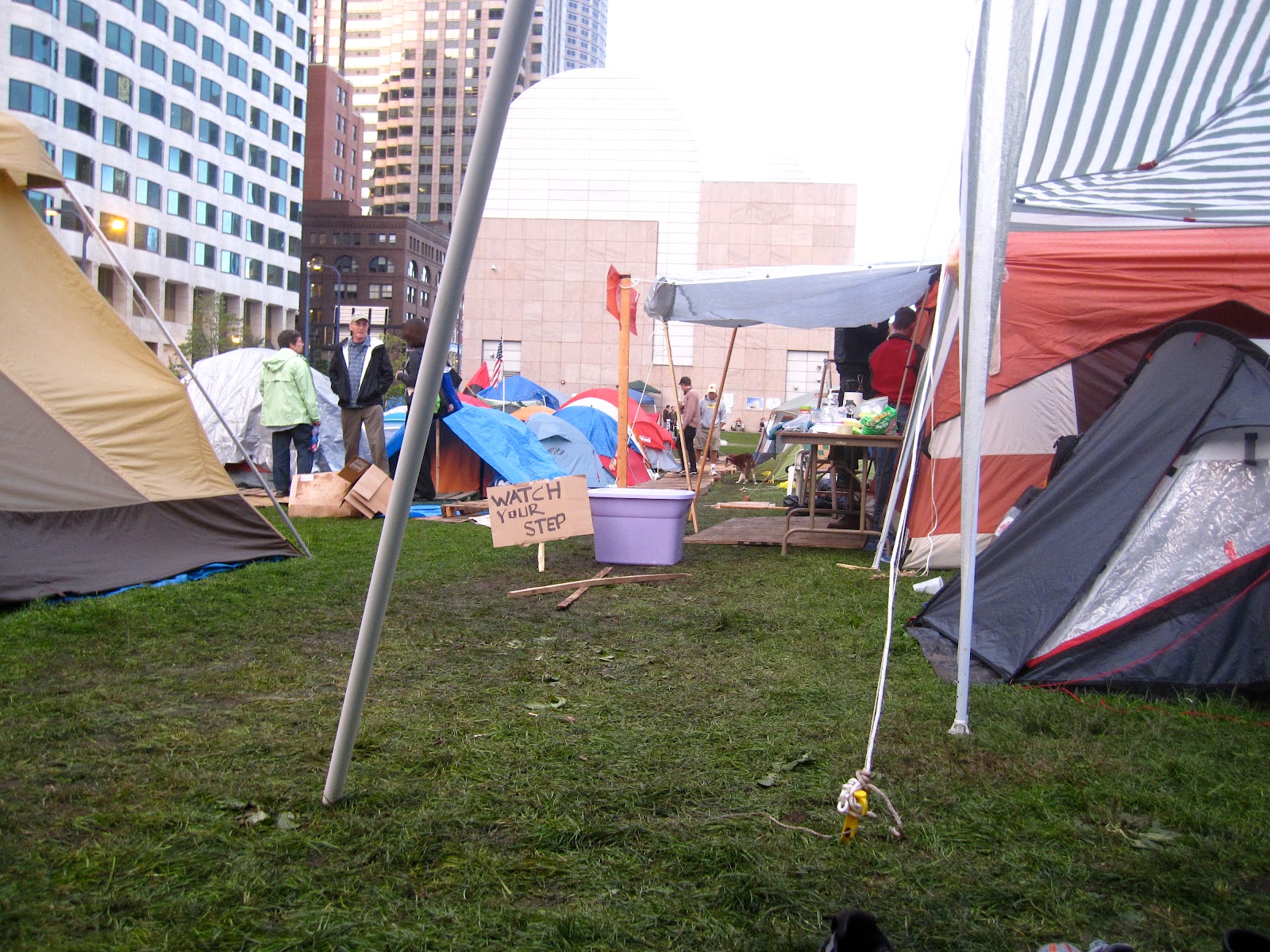
A view of the occupation, located outside of South Station

A general assembly meeting at the tent city

Many occupiers find these numbers very concerning

Thursday, September 15, 2011

Humane bug catcher

As someone who is very afraid of bugs (though I'm working to change that) and very uncomfortable with killing things, a problem arises every time I find a bug in my house. I've recently been trapping them under cups for my dad or Nate to bring them outside, but I don't like walking around with bug/cup sets all over my floor and counters (there can be a lot of bugs in my house) and I feel like I'm kind of torturing the bugs.

Solution: For a while I've been envisioning a fly swatter that captures flies, and all kinds of bugs, instead of squashing them. Today I finally googled it--and it exists! PETA has them for $12.


Also, apparently President Obama killed a fly during an interview a couple of years ago and PETA sent him one of these.

Critic 'jimspar' says, "if you love bugs so much why don't you marry them." Hmm.

On the other hand, Stephen Colbert and friend contend that "There can never be enough apologies."


More humane animal control products: DIY humane fruit fly trap, frog saver lily pad for pools, humane mousetrap, and animal rescue car kit


My next invention idea: Filters that go inside your nostrils to protect you from secondhand smoke.

Luckily, BSU became a smoke-free campus this year, so I am less worried about my exposure to smoke than I was last year.


*Update: Nose filters (aka nasal filters) exist!

Wednesday, September 7, 2011

One of Einstein's non-scientific contributions

My friend Christine recently blogged about this quote by Einstein that I like so much I decided to post it here too.

(Background is Australian Aboriginal art, font is Parker's Hand, one of my recent free Photoshop downloads)


"Everyone is a genius, but if you judge a fish by its ability to climb a tree it will spend its whole life believing it is stupid." -Einstein

This reminds me that I never finished reading A Briefer History of Time last year! I got to page 30 and kept reading it and rereading it, but couldn't get it. This time I'll try to read Prisons of Light - Black Holes since it is said to be easy to understand.

Black holes, I want to understand you!

Friday, August 26, 2011

How rich are you?

I just stumbled upon this website that tells you how your annual income compares to the annual incomes of the rest of the people in the world. It can be pretty surprising:

Global Rich List

My seventeen thousand dollar car