Showing posts with label politics. Show all posts

Friday, September 18, 2015

Reflections from my time in Uganda

I just came across this draft of a blog post that I wrote while I was in Uganda last year. It really surprises me how much I had forgotten about from my experience there. Here are my reflections on spending a month living and volunteering in Kampala, the capital of Uganda in 2014.

***

Kampala, Uganda

I keep searching for some sort of point I want to make based on my experiences here, but for the most part nothing is coming up. I've thought about writing about how it feels to be white in a country that's something like 99.5% indigenous, or how confusing I've found the social norms about touching, or how sometimes people seem more friendly here than in Boston.

I'm scared to write about my experiences in Uganda, because I'm pretty sure there are books about how offensive the ways that Westerners tend to write about Africa are. Since I'm white and relatively rich, I'm the perfect candidate for being ignorant about this sort of thing.

Also, I don't really know what to say. I haven't learned any concrete life lessons that I can think of, and I don't have any insightful observations. I guess this is because Africa, Uganda, Kampala are real places with all different kinds of people, places, and things. I don't want to make it into a caricature of a place just so I have something definitive to say.

I'm just going to share with you some general observations and reflections, and if I'm coming at it from an offensive angle, it could be good to get constructive criticism on that.

1. Touching seems to have very different connotations here. I still don't really understand it. Men that I work with (I mostly work with men) sometimes hold my hand for minutes at a time, or rub my arm while they're talking to me. I'm told that hand holding is not considered romantic here, but I always feel like they're coming onto me when this happens. I'm not sure if it's a gendered thing; I hear men hold hands casually with each other, too.

2. There are a lot of large, concrete walls with barbed wire separating properties. Also, there are lots of men with gigantic guns standing around; I'm told they're security guards, hired by local businesses.

3. People (mostly men) call out to me constantly as I walk down the street. They say, "Hello, how are you?" or, "Muzungu, how are you?" (muzungu = white person; I'm told it's not a derogatory term). At first I thought this was street harassment, so I didn't respond, but then I saw that my female friend just said hello back. I tried that, and found that the conversation usually ends there. Sometimes people are trying to sell me things, but often it seems like they're just curious. Every once in a while it's, "Hello baby!" and then I don't respond.

4. I feel like an outsider, but not really in a bad way. I expected people here to resent me for having so much more privilege and resources than most of them, but I haven't gotten that impression from anyone. People do seem to assume that I'm rich because I'm white, but they aren't hostile to me; they just want me to buy their products/services.

And they're right -- I am rich here. It's really weird for me. I can go to the fanciest restaurant I find (there are plenty of fancy restaurants here), buy an entree, a cocktail, and dessert, and it might cost me around 40,000 shillings (about $16).

In Boston, I'm more frugal than most of the people I know. I try to limit my unnecessary spending because it seems unfair for me to have much more than I need, while so many other people in the world don't have enough. But I'm skeptical of charity, and haven't found a way to combat financial inequality that I feel confident in. So I end up not spending much, and not donating much, and having money leftover.*

While I'm in one of the poorer countries in the world, it seems to me like it makes sense to spend money more frivolously. Isn't supporting local businesses a pretty direct way to get money to people with less money and resources?

Shopping at the market feels like a very direct way of supporting local Ugandans. I don't know what the shop owners' financial situations are like, but most of the shops are shacks that resemble the houses in the nearby slums, so I'm under the impression that they're not on the richer end of the Ugandan wealth spectrum. Conveniently, I really like shopping at the market. It's full secondhand clothes (my favorite), local produce, and often cute animals wandering around.

I usually barter when buying something at the market, partly because everyone I know tells me to. Also, I get the impression that people expect you to barter, so they jack up the price when you ask how much something is (prices are rarely marked). If I take it for the first price, I feel like I'm getting ripped off. But it seems weird to try to pay less for something when I can afford the higher price, and the money is likely worth much less to me than it is to the person I'm bartering with. On the other hand, I wonder if it would be ostentatious for me not to barter, because it is a part of the shopping experience.

5. I regularly find myself at fancy restaurants and touristy stores, which feels uncomfortable. Sometimes almost everyone in those spaces is white, and I wonder why I've gotten myself into a white people bubble in the middle of a 99.5% brown country. Sometimes when I go to these places it's because someone I know invites me to them, and other times it's because I feel physically safe going there alone, and they have things I'm used to (i.e. they take credit cards, I don't need the menu items explained to me, etc.).

*Note: At the time of publication, this is no longer the case. I spend a lot more money on housing than I used to, and I make less money than I used to because of irregular work hours.

Thursday, February 2, 2012

Small grants available for Occupy movement artists

A network of artists and activists called The Culture Group is launching a new project to support Occupy artists, called ArtIsMyOccupation.

"Cultural change precedes political change."
FOUNDATIONAL BELIEF OF THE CULTURAL GROUP


ArtIsMyOccupation (AMO) is a project founded by artists and for artists who are involved in Occupy and other movements for Economic Justice. Our sole mission is getting artists who are working on the front lines of social change the resources they need.

Have a great idea for a project? Apply for a grant.

Want to collaborate other Occupy artists or campaigns? Get Connected

Want to see what upcoming mass actions to create work for? Get inspired

[Most of the text of this post is copied directly from AMO founder, Favianna Rodriguez's blog]


Wednesday, January 25, 2012

Talking about menstruation!


I spend about 1/5 of my time menstruating. Most of my sick days are due to menstrual cramps. I get period blood on my fingers when I remove/insert my menstrual cup.

My period is a substantial part of my life.

So why is it taboo to talk about something that is a substantial part of the lives of every female in the world?

You'd Think We'd Never BledBook: Avoiding the Topic of Menstruation Since 1903
From Adventures in Menstruating

"Your health worries explained: Let's all just pretend there's nothing down there!"

This reminds me of the many unsatisfying experiences I've had with doctors on the topic of my vagina, including having to teach my doctor what a menstrual cup is just a few weeks ago (they're not that uncommon!).


In my opinion, our culture's unwillingness to talk about menstruation oppresses females in a lot of ways:


1. It sends the message that this bodily function is gross and unmentionable, which discourages females from loving their bodies.

2. It fails to educate girls about menstruation. Some girls never hear of menstruation at all before their first period (and therefore assume they're wounded, which can be traumatic).*

And the conversation that our culture does have about menstruation focuses on sanitary products, not the significance of fertility or womanhood.

*This info is from The Body Project.

3. It produces men who lack an understanding of menstruation.

4. It leaves females unskilled at talking (and questioning) about their bodies because they have not learned comfortable (or any) words to identify their body parts.

"Women still struggle to find a vocabulary that does not rely on Victorian euphemisms, medical nomenclature, or misogynistic slang." -Joan Jacobs Brumberg, The Body Project
I totally struggle with finding a vocabulary to talk about my body. What do I call my vagina? "Vagina" sounds a bit too medical, "pussy" is a word people use to insult each other, and any sort of euphemism is totally against my passion for bluntness.


There is a movement called menstrual activism, radical menstruation, menstrual anarchy, or menarchy that strives to change the ways that menstruation is dealt with by society.

Menstrual activism may include:
-Speaking openly about periods
-Challenging negative attitudes toward menstruation
-Campaigning for more environmentally friendly sanitary products
-Campaigning for safer sanitary products

"Do we have to regard our period as something dirty? Do we have to greet a girl's first period with silence?" -Chris Bobel

Pagan menarche ceremony
Some cultures have rituals for menarche (a girl's first period) that celebrate the girl's rite of passage.

I can see how the above photo might seem silly to a lot of people -- white, Western women imitating tribal rituals that they likely have no ties to. But I think there is good in it. It can be a good thing for people from one culture to adopt the practices they value from other cultures.

A menarche ceremony:


1. Helps a girl to feel welcomed into the world of womanhood (through the sharing of stories, the celebration of womanhood, etc.).


2. Provides a girl with an opportunity to contemplate the weight of her newly found ability to make babies.

3. Fosters solidarity and bonding among all of the women and girls involved.

4. Creates an opportunity for those who have had their periods for a time to share stories -- funny stories, embarrassing stories, stories of lessons learned, etc. which can help the newly menstrual girl gain an understanding of menstruation in an emotional and spiritual light (as opposed to learning just the medical facts, like how to use a tampon).

5. Brings meaning and gratification to the life-changing event. If a girl's first period is not acknowledged beyond the purchase of sanitary products, it may feel unfulfilling (like when it's your birthday, but it doesn't feel like your birthday).

6. Helps a girl to feel more in tune with her body and nature by allowing this naturally occurring event to dictate when a ceremony will take place.

To clarify:


Do feminists hate men? I'd estimate that most feminists do not hate men, though some might. Feminism is "the theory of the political, economic, and social equality of the sexes" (Merriam-Webster Dictionary), not the theory that any gender is better than another.

Do I think a menarche ceremony is the only meaningful way to address menarche? No, I just think it can be a good way to do it, but I'm sure that some girls would prefer not to share this experience with friends and parents' friends. Of course, a girl's preferences and feelings should be central to how her first period is addressed.


Activists combat the notion that menstruation is gross:


A piece from Ingrid Berthon-Moine's collection of photos of women wearing menstrual blood as lipstick
"consider the idea of tasting your own menstrual blood" -Germaine Greer

Ingrid Berthon-Moine's "Red is the Colour"


Painting using menstrual blood


Why do I think these quirky artistic endeavors are worth mentioning?


1. They send the message that menstruation is beautiful. They feel to me like celebrations of womanhood and menstruation.

2. Since switching to a menstrual cup (instead of tampons/pads), I have been looking for ways to use my own period blood (because a menstrual cup collects it in the cup, rather than absorbing it into fluffy material). Menstrual blood seems potentially useful -- I've considered using it as a dye. I hadn't thought to use it as paint, but that seems like a worthwhile project. It makes a point and it is free paint (paint is expensive!).

3. I think art is a powerful form of peaceful activism.

Monday, December 5, 2011

Us us us us us us, and them them them them them them: Americans & Iraqis

My hope is that this post allows various Iraqi voices to speak for themselves, rather than me making a case for them.


"You're American and we're Iraqi. You're not Bush and we're not Saddam."
-ANONYMOUS IRAQI MAN

Quote as recalled by United Statesian activist Jodie Evans. The man was responding to her question: "Why are you being so nice to us?"

Jodie Evans spoke at this year's Connecting for Change conference, which I went to and enjoyed. Presenters and workshops explored topics including youth empowerment, environmental activism, women's rights, local food, alternative journalism, healthy school lunches, and wild edibles*.
 
*This link is for the 2012 wild edibles workshop because I couldn't find a page about the one they had in 2011.

You can see Jodie's entire 22 minute speech here.


Shoot an Iraqi describes an artistic endeavor of Wafaa Bilal, an artist and professor who immigrated to the U.S. from Iraq in 1992 to escape repression under Saddam Hussein’s regime. In 2007, he spent a month in a small Chicago gallery in the line of fire of a paintball gun that people could shoot at him over the internet. Internet viewers could also see and chat with Wafaa. By the twentieth day, he had been shot at over 40,000 times, and hackers had programmed the gun to fire automatically. By the end, more than 60,000 people (people, not just shots) from 130 countries shot at him.

Yellow paintballs were used because yellow is the color of the Support Our Troops ribbons


"Uprooted" by Iraqi artist, Naman Hadi

"Birth" by Iraqi artist, Dalia Mohammad

"Kliem of the South" by Iraqi artist, Ahmed Nussaif


Also,

Wednesday, November 23, 2011

The New Yorker's cover addresses Thanksgiving/immigration controversy

The cover of The New Yorker's Thanksgiving issue
Illustration by Christoph Neimann
The title of this piece is "Promised Land."

The artist, Christoph Neimann, commented:

"I'm an immigrant myself and what I always found staggering is that there are tons of Europeans who get green cards and I know some of them are not legal from the get-go and that never comes up. Having a racial undertone in this debate is extremely hurtful. It shouldn't have anything to do with where the immigrant comes from."

The Huffington Post just published a really interesting article about this.


Here are a few other noteworthy works by the same artist:

"Dependence Day"
"Divided We Stand"
"S.O.S."
"Dark Spring"
(like Silent Spring)

Saturday, November 12, 2011

National Day of Mourning, or: Thanksgiving


It turns out that this lovely American holiday is protested by many Native Americans--and for good reason.

"The pilgrims did not come here seeking religious freedom; they already had that in Holland. They came here as part of a commercial venture. They introduced sexism, racism, anti-lesbian and gay bigotry, jails, and the class system to these shores."

"[The Europeans] would not have survived their first several years in "New England" were it not for the aid of Wampanoag people. What Native people got in return for this help was genocide, theft of our lands, and never-ending repression. We are [now] treated either as quaint relics from the past, or are, to most people, virtually invisible."

"On many reservations, unemployment rates surpass fifty percent. Our life expectancies are much lower, our infant mortality and teen suicide rates much higher, than those of white Americans. Racist stereotypes of Native people, such as those perpetuated by the Cleveland Indians, the Atlanta Braves, and countless local and national sports teams, persist. Every single one of the more than 350 treaties that Native nations signed has been broken by the U.S. government. The bipartisan budget cuts have severely reduced educational opportunities for Native youth and the development of new housing on reservations, and have caused cause deadly cutbacks in health-care and other necessary services."

[quotes from this great article]

National Day of Mourning


Since 1970, the United American Indians of New England have been coming together for a protest on the National Day of Mourning to "speak the truth about our history and about current issues and struggles [Native Americans] are involved in." The National Day of Mourning is a day (which intentionally coincides with Thanksgiving day) set aside to, "mourn ... the genocide of our peoples and the theft of our lands. NDOM is a day when we mourn, but we also feel our strength in political action."


The National Day of Mourning in 2008

This year's National Day of Mourning is dedicated to Native political prisoner Leonard Peltier, who was framed by the FBI and has been falsely imprisoned since 1976.


A flier I made to inform people about the National Day of Mourning protest. Feel free to print it and post it if you want.

Should I stop celebrating Thanksgiving?


I am actually comforted by how much many holidays have lost their meanings. There are holidays that I wouldn't want to celebrate if their origins were important parts of the celebrations. I am much more comfortable celebrating "Santa Day," "Bunny Day," and "Turkey* Day" than I would be if we were earnestly celebrating Jesus' birthday, Jesus' rise-day, and whites-and-Indians-get-along-so-well day.

At the same time, I think that celebrating Thanksgiving does give the impression that all is well with the Thanksgiving story (though it would give that impression more severely if the Thanksgiving story were more prevalent in Thanksgiving celebrations). For me, however, I think that choosing not to celebrate Thanksgiving with the conventional feast would be hurtful to my family, so I am going to continue celebrating it until I find a better option. But if I can figure out a way to go to the National Day of Mourning protest and be back in time for Thanksgiving dinner with my family, I will definitely do that.

Let me know if you want to go!

*I prefer to think of Thanksgiving as "Stuffing Day" because I don't eat turkey, but I love stuffing.


By the way, want to sign a pledge to "Drop the I-word"?


Tuesday, October 4, 2011

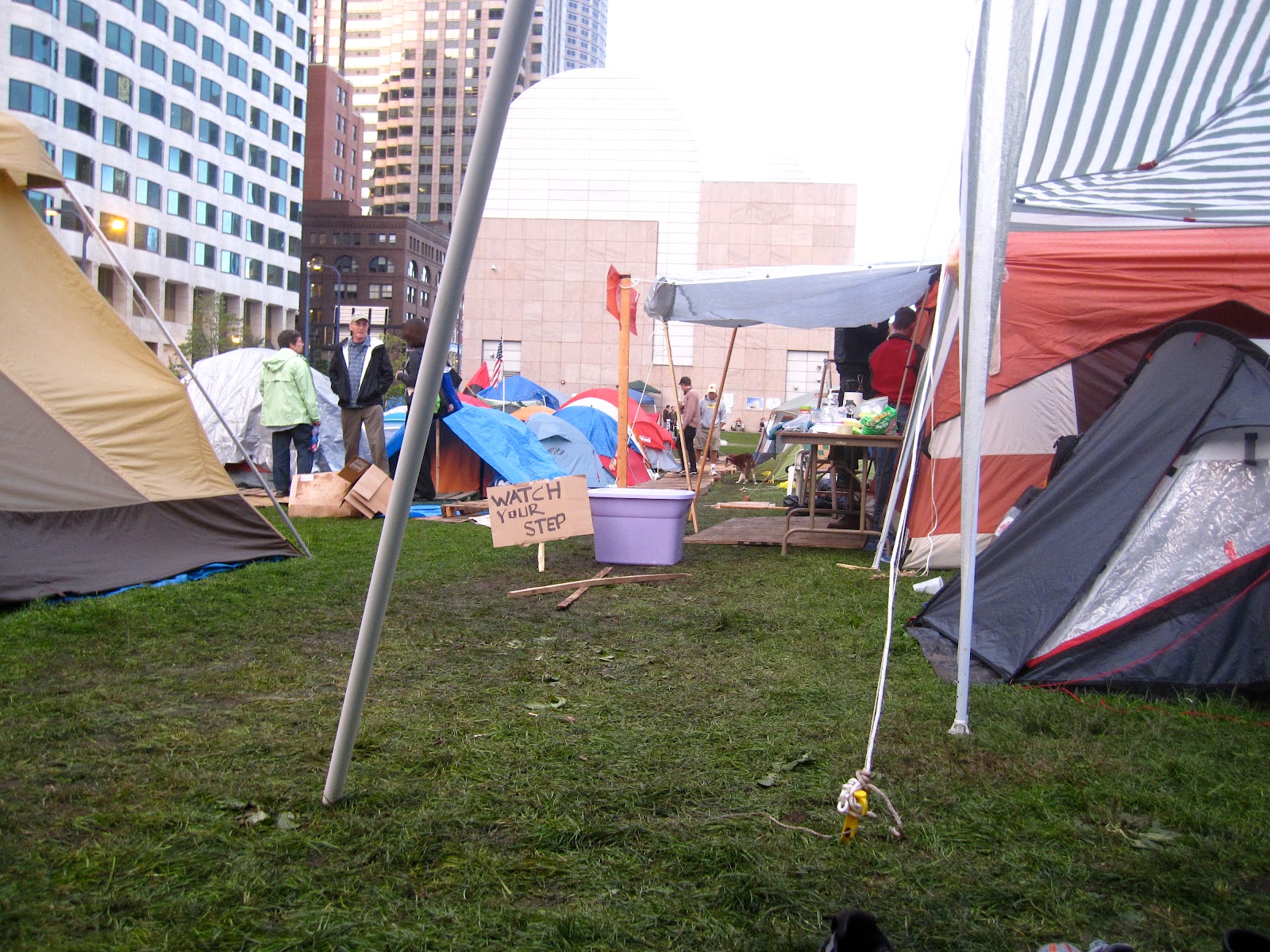
Trying out democracy: The first days of Occupy Boston

I've been spending a lot of time at Occupy Boston. I am very enthusiastic about this movement and hoping to do what I can to support it and keep its energy up.
Here is a podcast in which 3 participants of the Occupy movement give eloquent explanations of their involvement in the movement:
NPR's On Point with Tom Ashbrook on the Occupy movement
Some photos I took at Occupy Boston during the first days of the movement in Boston:
Marching outside of Bank of America

Marching outside Bank of America

One protester, Nikki Sauber

Inside the spirituality tent

A view of the occupation, located outside of South Station

A general assembly meeting at the tent city

Many occupiers find these numbers very concerning

Saturday, September 3, 2011

Me gloating about the adventure I am about to embark on

Nate and I are going on our first ever road trip together! (It's his first ever road trip, and my first ever road-trip-with-Nate.) The last and only other road trip I went on was with my dear old friend Katie McGuire and it was an absolute all around good time. There were kittens, puppies, Amish people, historic monuments (especially that extremely famous one I always mix up with the Eiffel Tower--any guesses?), magical glass trees, scary motels, yard sales, peace-inducing open fields, a direct correlation between gas prices and our location on the east coast, and a general feeling of freedom.

Here are some relics from that beautiful week of my life:

This trip was a big part of the reason that Pennsylvania is my favorite state (as pictured)

The magical glass tree outside an art museum in Baltimore

We stayed in a bed and breakfast owned by Mennonites, who let us hang out with their kitten
So overall the road trip of 2008 was probably the most enjoyable experience of my life so far.

This time around, we are going to take a slightly different approach to travel because I found out about this thing called CouchSurfing!


This means that we don't have to stay in a motel ever again! We will now be staying with Christina in the Bronx for two nights and Adam in Connecticut for one night. Thanks to CouchSurfing, even though Nate and I don't know Christina and Adam at all, they are letting us live in their apartments for free. And we will probably hang out with them as if they are our friends. I love this!

There is some recent controversy about CouchSurfing changing from a nonprofit to a B Corporation.


B Corporations, or Benefit Corporations, "must by law create a material positive impact on society; consider how decisions affect employees, community and the environment; and publicly report their social and environmental performance using established third-party standards."

"I emailed [CouchSurfing] to request a refund of my donation. I suggest you do the same if you use this website." -my friend Dylan, via Facebook

As of right now, I don't care very much about the change because CouchSurfing is such an awesome resource for me.

Tuesday, March 22, 2011

Escaping Advertisements

[This post is part of Bridgewater State University's Blogfest for Social Media Week. Today's theme: technology]


I just found this awesome add-on for Firefox that replaces internet ads with art! It's called Add-Art and it's free.

I just downloaded it, and this is how it looks:

The picture of the kids is where the ad would have been--poetry websites have the worst ads. They often have sound, but it seems that Add-Art eliminates the sound, too.

So far, most of the art consists of surprisingly un-arty photos, because the current installation, See Space, was created by children ages 6-15 at an after school program. But it's still fun, and the collection changes periodically.

(From adbusters.org)

(From adbusters.org)

The average United Statesian sees thousands of advertisements each day. In Europe, there is a ban on advertisements that 'exhort children to purchase or to ask their parents or others to make inquiries or purchases' and in Sweden all advertisements aimed at children under 12 are banned.

In 2007, Sao Paulo, Brazil's largest city, banned all outdoor advertisements, including pamphlets, in an attempt to reduce "visual pollution."

Sao Paulo before and after the advertising ban

Once the billboards were all taken down, there was a lot of waste, which Brazilian designers TOUCH and StraaT made tote bags out of.


Some ideas on how to combat advertisements:

1. Try a Buy Nothing Day, and maybe even invite others to do it with you. It might be harder than you'd expect.

2. Avoid buying from big companies:
       For clothes, try thrift shops
       For food, try farm stands and small grocery stores (especially ones that offer local food)
       For gifts, make something by hand
       For hygiene products, make them yourself (from items bought at small grocery stores)
       For gas... bike? Take the train? When you do need gas, it's probably better to buy from an independently-owned gas station, like Easton Gas

3. Download Add-Art so at least you won't have to look at ads when you're on the computer.


Any other ideas?

Thursday, July 22, 2010

Military advertising

Air force billboard I've seen all over the place recently:


How I read it:


I really think advertising should be strictly informational, not persuasive. But everyone tells me that will never happen. Also, why is the air force reserve's domain name .com, not .gov or .mil?